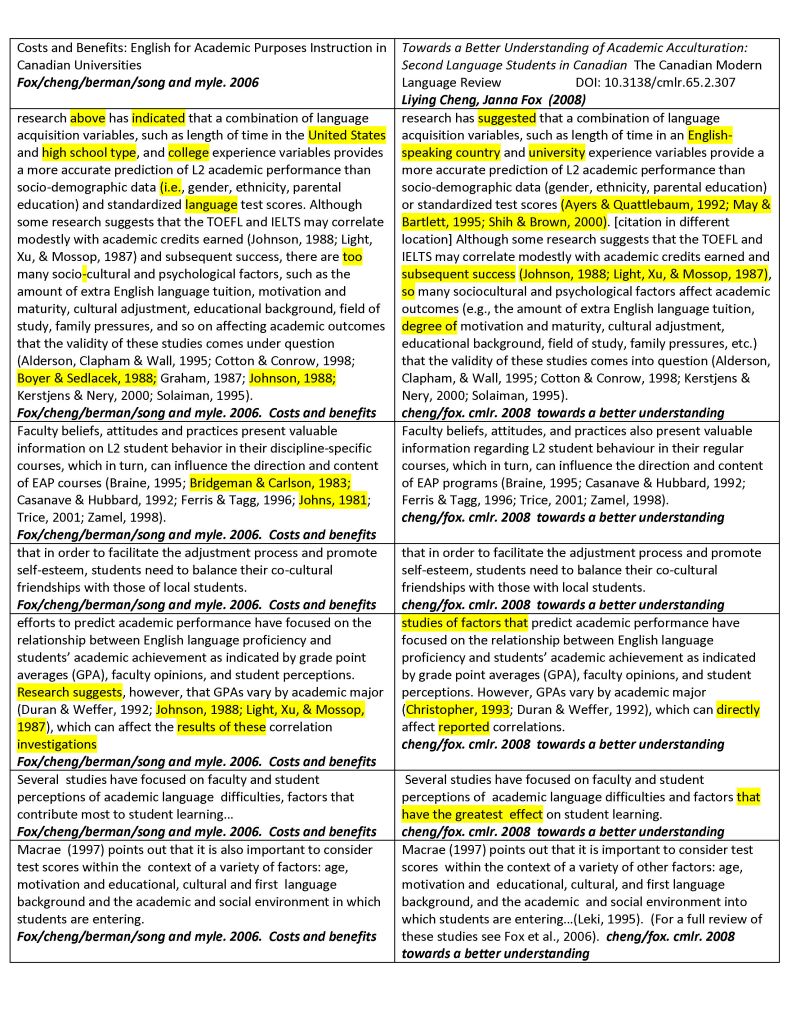
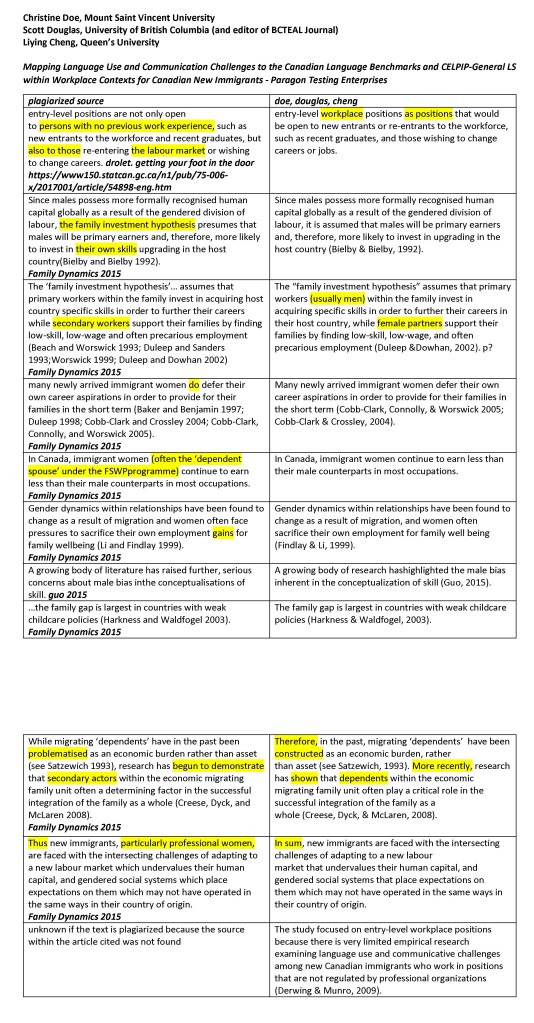
Some of the plagiarized passages from Cheng’s 2015 “State-of-the-Art Article”, Review of washback research literature within Kane’s argument-based validation framework.
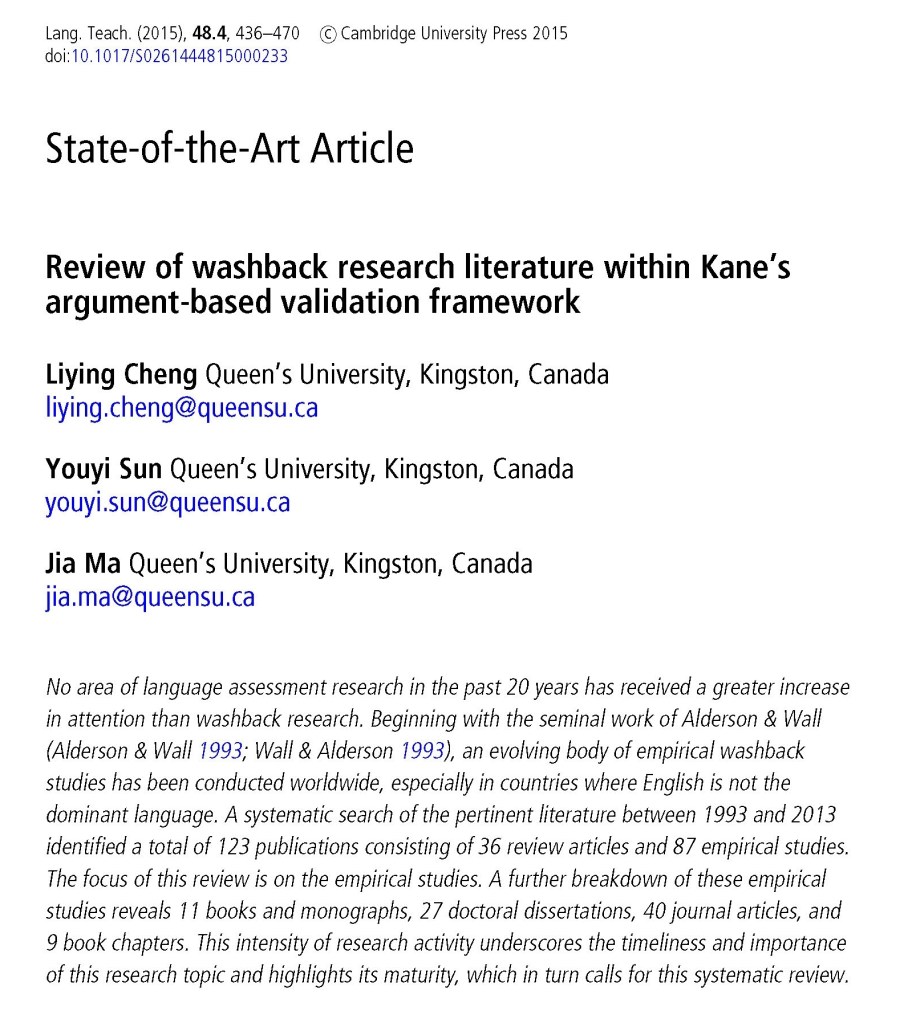
Some of the plagiarized passages from Cheng’s 2015 “State-of-the-Art Article”, Review of washback research literature within Kane’s argument-based validation framework.
Geopolitics of Assessment
The TESOL Encyclopedia of English Language Teaching
Teaching English as an International Language
Liying Cheng
First published: 18 January 2018
https://doi.org/10.1002/9781118784235.eelt0814
This recent article is another one of Cheng’s that is mostly a patchwork of plagiarized passages. I stopped documenting the plagiarizations at the top of page 5.
Questions, comments, and corrections send to zeewu@protonmail.com.
Liying Cheng, Queens University – “Since 2000 after [sic] Liying joined Queen’s Faculty of Education, she has obtained research funding totalling more than 1.7 million Canadian dollars. In addition, she has conducted more than 220 conference presentations and has more than 140 publications. Her recent books are Assessment in the Language Classroom: Teachers Supporting Student Learning (co-authored with J. Fox, 2017); Language classroom assessment (single-authored, TESOL, Inc., 2013)” https://educ.queensu.ca/liying-cheng Last accessed 12/2019
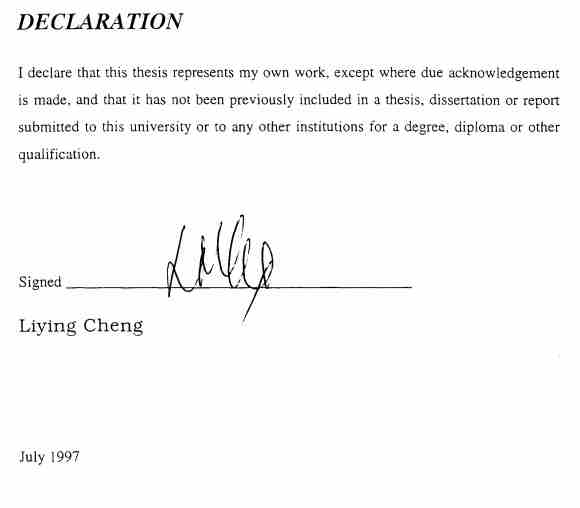
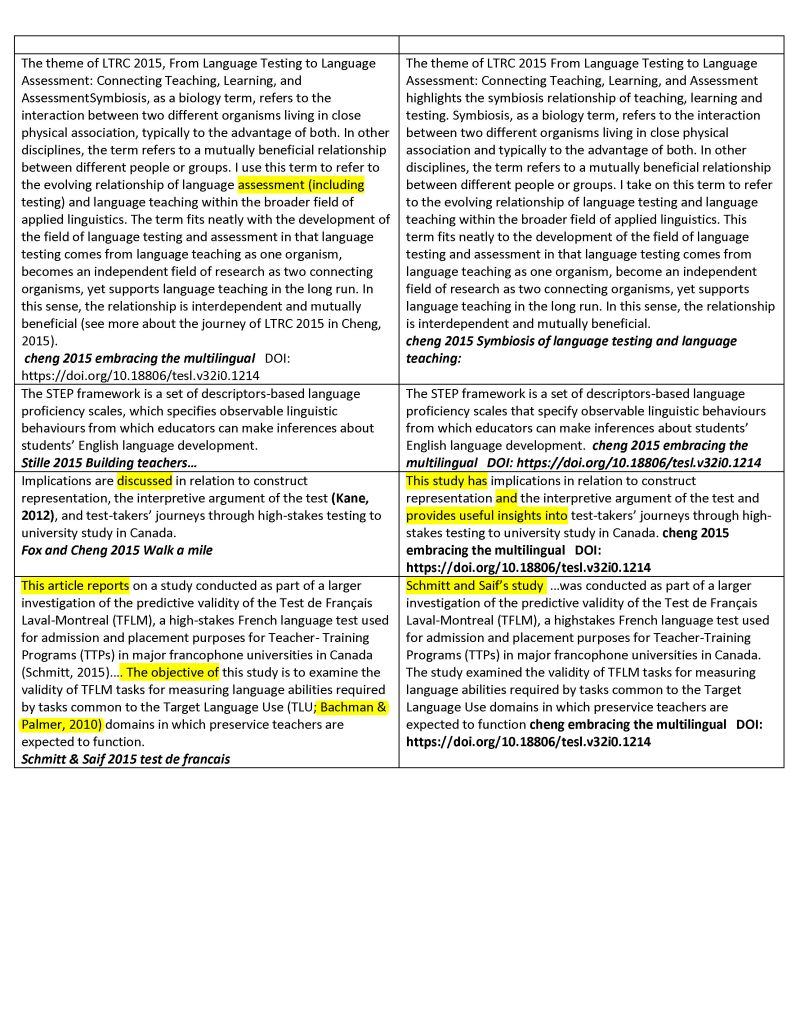
Samples of Cheng’s plagiarizations.
As guest editor for a special issue of TESL Canada Journal , Cheng copies and pastes abstracts from the issue’s articles into her introduction. She also copies parts of the introduction and pastes them into an article in a different journal, or vice versa. Note that the citations in the original article from other authors are not included in Cheng’s copy. This patch writing is common in her work.
DOI: https://doi.org/10.18806/tesl.v32i0.1214
“Honesty, trust, fairness, respect, and responsibility.”
Centre for Academic Integrity (1999)
Contents:
1. Queen’s University Faculty Association Agreement
Article 17.2.1 – Fraud & Misconduct in Academic Research and Scholarly Activity
Fraud or misconduct in academic research or scholarly activity may include, but is not limited to, one or more of the following:
(b) Plagiarism
(c) Failure to recognize by due acknowledgement the substantive contributions of others
(e) Attribution of authorship to persons other than those who have participated in the work sufficiently to take responsibility for its intellectual content;
(f) Submission for publication of articles originally published elsewhere except where it is clearly indicated in the published work that the publication is intended to be a republication;
2. Carlton University. General Regulations 14.1
The Senate of the University has enacted the following regulations for instructional offences at the graduate level: Any student commits an instructional offence who:
(b) submits substantially the same piece of written work to two different courses. Minor modificationconstitute a significant and acceptable reworking of an essay or paper…
(d) commits an act of plagiarism. Plagiarism will be deemed to have occurred when a student either:
(i) directly copies another’s work without acknowledgement; or
(ii) closely paraphrases the equivalent of a short paragraph or more without acknowledgement; or
(iii) borrows, without acknowledgement, any ideas in a clear and recognizable form in such a way as to present them as the student’s own thought, where such ideas, if they were the student’s own, would contribute to the merit of his or her own work…
3. Liying Cheng, Janna Fox, Jia Ma bona fides
4. The copyrighted articles and books plagiarized by Liying Cheng, Janna Fox, and Jia Ma
5. The publications by Liying Cheng, Janna Fox, and Jia Ma that contain plagiarized content
6. The green button links to a pdf file of the plagiarizations I’ve seen so far. It is unlikely that the multiple plagiarizations observed in the small sample of their work are isolated incidents.
7. A sample of Cheng’s and Fox’s plagiarization:
Copied from: Summative Assessment:
Summative assessments are used to evaluate student learning, skill acquisition, and academic achievement at the conclusion of a defined instructional period—typically at the end of a project, unit, course, semester, program, or school year. Generally speaking, summative assessments are defined by three major criteria: The tests, assignments, or projects are used to determine whether students have learned what they were expected to learn. In other words, what makes an assessment “summative” is not the design of the test, assignment, or self-evaluation, per se, but the way it is used—i.e., to determine whether and to what degree students have learned the material they have been taught. Summative assessments are given at the conclusion of a specific instructional period, and therefore they are generally evaluative, rather than diagnostic—i.e., they are more appropriately used to determine learning progress and achievement, evaluate the effectiveness of educational programs, measure progress toward improvement goals, or make course-placement decisions, among other possible applications. Summative-assessment results are often recorded as scores or grades that are then factored into a student’s permanent academic record, whether they end up as letter grades on a report card or test scores used in the college-admissions process. While summative assessments are typically a major component of the grading process in most districts, schools, and courses, not all assessments considered to be summative are graded.
Copied to: Cheng/Fox: Assessment in the language classroom: teachers supporting student learning. p5
Summative assessment is used to evaluate student learning, skill acquisition and academic achievement at the conclusion of a defined instructional period – typically at the end of a project, unit, course, semester, programme, or school year. Summative assessment is in line with assessment of learning. Generally speaking, summative assessment is defined by the following three major criteria: ●● Tests, assignments, or projects are used to determine whether students have learned what they were expected to learn. In other words, what makes an assessment ‘summative’ is not the design of the test, assignment, or self-evaluation, per se, but the way it is used, and the decisions made based on the assessment, that is, to determine whether and to what degree students have learned the material they have been taught. There is usually an evaluation mark given. ●● Summative assessments are given at the conclusion of a specific instructional period, and therefore they are generally evaluative, rather than diagnostic, that is, they are more appropriately used to determine learning progress and achievement, evaluate the effectiveness of educational programmes, measure progress towards improvement goals, or make course-placement decisions, among other possible purposes. ●● Summative-assessment results are often recorded as scores or grades that are then factored into a student’s permanent academic record, whether they end up as letter grades on a report card or test scores used in the university-admission process. Summative assessments are typically a major component of the grading process in most courses and programmes.
From Wikipedia
“Queen’s caught up in bitter ‘self-plagiarism debate”
–Margaret Munro, postmedia http://www.canada.com/technology/queen+caught+bitter+self+plagarism+debate/3959947/story.html
Munro: “Four of Smith’s papers have subsequently been retracted by scientific journals at the urging of whistleblowers Mort Shirkhanzadeh and Chris Pickles of Queen’s mining and materials department. The most recent retraction this fall was made by the European and British editors of the Journal of Materials Processing Technology, who pulled one of Smith’s duplicate papers saying it was “a severe abuse of the scientific publishing system.””
Munro: “He [professor steve iscoe] says the Smith case raises several troubling questions, including whether the repeat publications helped him obtain federal grants and whether Queen’s students are being held to a different standard than professors. Queen’s integrity rules say “submitting the same piece of work in more than one course without the permission of the instructor(s)” qualifies as plagiarism.
“Queen’s 2005 internal investigation in the Smith case, which NSERC described as lacking thoroughness and “not sufficiently” arm’s length, concluded there was “no evidence” Smith had engaged in plagiarism.”
The journal that published Smith’s self-plagiarization responded differently:
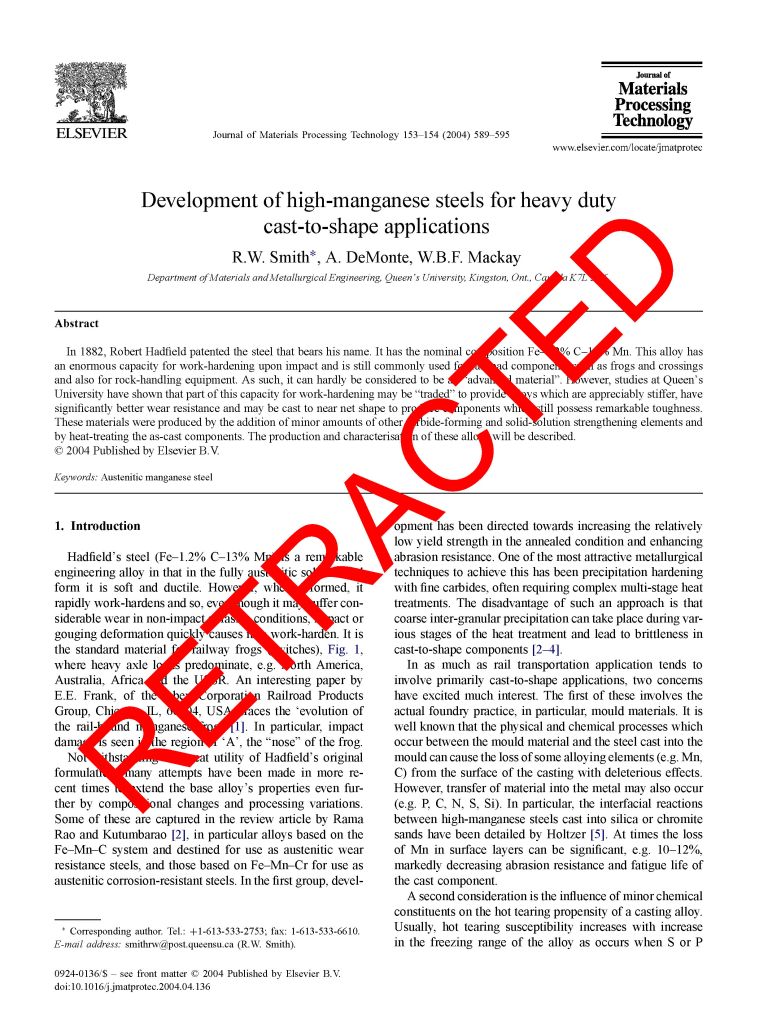
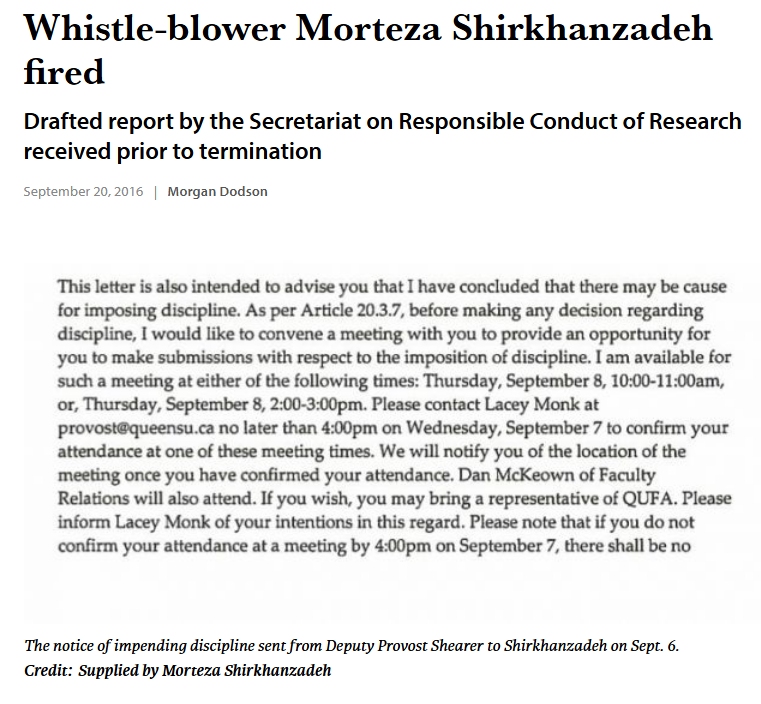
From the Queen’s University Journal 20 september 2016: